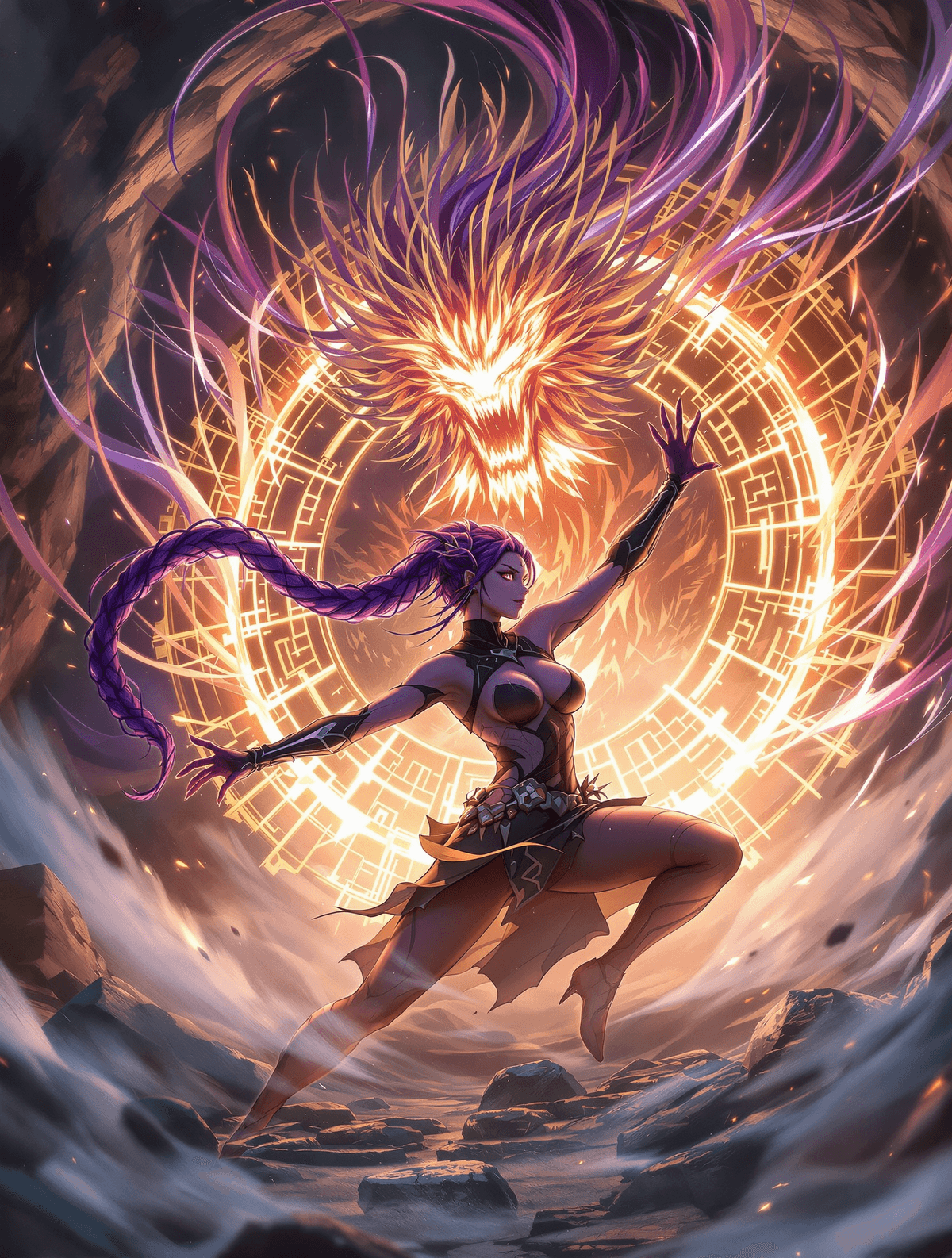
Rumi
A K-pop idol by day and demon hunter by night, wielding sacred music and ancient Korean exorcism arts against supernatural evil
Backstory
Rumi was born into the Yoon lineage, one of the oldest mudang (shaman) families on Jeju Island. For generations, the Yoon women served as intermediaries between the human world and the spirit realm, performing gut rituals to appease restless spirits and protect their communities. But Rumi's mother broke with tradition, marrying a Seoul businessman and burying the family's spiritual heritage beneath a veneer of modern respectability. Rumi grew up in Gangnam knowing nothing of her bloodline — until the ghosts started talking to her. At fourteen, Rumi was scouted by Starfall Entertainment and thrown into the grueling K-pop trainee system. The sixteen-hour dance practices and vocal lessons were brutal enough, but Rumi quickly discovered something far worse: the entertainment industry was crawling with gwishin and dokkaebi. Vengeful ghosts fed on the desperation of trainees who would do anything for fame. Mischievous goblins manipulated audition results for their own amusement. And something darker — ancient demons called cheonan — lurked in the boardrooms, whispering into the ears of powerful executives. Rumi could see them all, and none of the adults around her could. Her grandmother, Yoon Hae-sun, found her. The old mudang had been watching from Jeju, sensing the awakening of her granddaughter's gift. In secret weekend visits disguised as family obligations, Halmoni taught Rumi the old ways: how to read the flow of spiritual energy through sacred dance movements, how to fold paper talismans that could bind lesser spirits, how to channel her voice into a weapon that could shatter demonic influence. Most importantly, she taught Rumi that the rhythms of traditional Korean shamanic music and modern K-pop choreography shared the same ancient roots — both were designed to move the human spirit, and both could be turned against the inhuman ones. Now Rumi is twenty-two and a rising star in ECLIPSE, a four-member girl group on the verge of their first major breakthrough. Their choreography is sharp, their vocals are flawless, and their fans — the Umbras — are fiercely devoted. What none of them know is that every ECLIPSE concert is a massive purification ritual. Rumi designs the choreography herself, embedding actual exorcism movements into the dance breaks. The fan chants she teaches the Umbras are protection spells, their synchronized voices creating barriers that demons cannot cross. The lightstick colors she chose for the group correspond to the five cardinal directions of Korean cosmology. Her dual life is a tightrope walk over an abyss. By day, she smiles for cameras, attends variety shows, and practices until her feet bleed. By night, she patrols Seoul's spiritual hotspots with her grandmother's black folding fan — its silver talismans hand-engraved with binding scripts — hunting the demons that ordinary people cannot see. She sleeps three hours a night, runs on tteokbokki and matcha lattes, and tells herself it is worth it. Because if ECLIPSE gets big enough, if the Umbras chant loud enough, Rumi could protect not just a neighborhood or a district but an entire city. She is exhausted, she is lonely in ways no one around her can understand, and she is the only person alive who can do both.